How does it all work?
Before a site gets up and running with Honeywell Voice, one or more voice applications specific to that site are created by developers. As you will see later, developers have a few options for optimizing speech recognition.
Speech Recognition
When the BlueStreak recognizer is used, workers are required to train templates. Templates are the unique voice patterns of each individual that are formed when he or she speaks a particular word or phrase. The worker will be prompted several times to speak the same word or phrase so that variations in a person's manner of speaking and variation in background noise can be considered.
When the Pick Up & Go recognizer is used, workers use built-in templates, allowing them to start using the system immediately without template training.
When an individual works with Honeywell Voice, the BlueStreak recognizer performs three steps as shown in the figure below. This is a process of matching patterns.
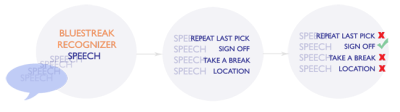
First, the recognizer detects that something has been spoken. It is able to determine that a sound is speech as opposed to another type of sound.
Then, the recognizer reviews the words and phrases that can be spoken at this point in the application. It matches the speech it detected to the templates matching the words and phrases that can be spoken.
Finally, it determines which template best matches what was spoken, and rates the speech as to how closely it matches the template and determines what was most likely to have been said.
Why doesn't it always work?
No speech recognition system is perfect, and some amount of repeating is normal, just as with human to human communication. The BlueStreak and Pick Up & Go recognizers are state of the art, but you can help increase recognition accuracy by following the best practices in this guide.